web analytics

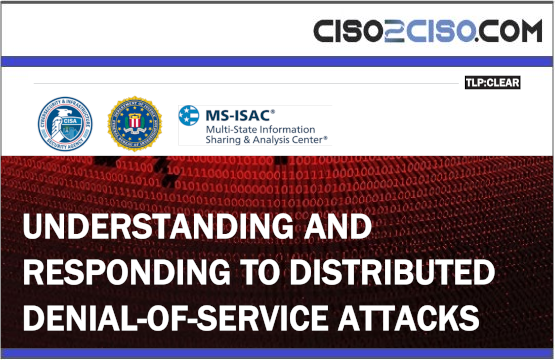
UNDERSTANDING AND RESPONDING TO DISTRIBUTED DENIAL-OF-SERVICE ATTACKS

Rate this post

The document titled “Understanding and Responding to Distributed Denial-of-Service Attacks,” published by the Cybersecurity and Infrastructure Security Agency (CISA), the Federal Bureau of Investigation (FBI), and the Multi-State Information Sharing and Analysis Center (MS-ISAC) on March 21, 2024, serves as a comprehensive guide aimed at federal, state, local, tribal, and territorial government entities. It addresses the specific challenges these organizations face in defending against Distributed Denial-of-Service (DDoS) attacks.

The document begins with a disclaimer regarding its classification under TLP:CLEAR, indicating that the information can be freely shared without restrictions. It outlines the purpose of the guide, which is to provide an overview of the DDoS landscape, including attack types, motivations, and potential impacts on government operations. It emphasizes the importance of proactive measures and incident response strategies to mitigate the effects of DDoS attacks.

The guide differentiates between Denial-of-Service (DoS) and DDoS attacks. A DoS attack typically originates from a single source, overwhelming a target system with traffic or resource-consuming requests. In contrast, a DDoS attack involves multiple sources, often utilizing botnets to amplify the attack’s impact, making it more challenging to defend against.

The document categorizes DDoS and DoS attacks into three main technique types:

  1. Volume-Based Attacks: These attacks aim to consume the target’s bandwidth or system resources by overwhelming it with massive traffic.
  2. Protocol-Based Attacks: These exploit vulnerabilities in network protocols to disrupt the target’s performance, typically targeting Layers 3 and 4 of the OSI model.
  3. Application Layer-Based Attacks: These target specific applications or services, exploiting weaknesses to consume processing power or cause malfunctions, focusing on Layer 7 of the OSI model.

The guide emphasizes that these categories are not mutually exclusive, as attackers can combine techniques to launch sophisticated attacks. It also highlights the evolving nature of DDoS tactics, necessitating continuous adaptation by defenders.

To prepare for potential DDoS attacks, the document outlines proactive steps organizations should take, including conducting risk assessments, implementing network monitoring tools, analyzing traffic patterns, and developing incident response plans. It also suggests employing DDoS mitigation services, increasing bandwidth capacity, and educating employees about DDoS threats.

The guide provides indicators to help organizations identify if they are experiencing a DDoS attack, such as website unavailability, network congestion, unusual traffic patterns, server crashes, and high resource utilization. It also advises on how to respond to a DDoS incident, including activating incident response plans, notifying service providers, gathering evidence, and implementing traffic filtering.

If an organization has suffered a DDoS attack, the document recommends assessing the impact, restoring services, performing post-incident analysis, and updating security controls. It emphasizes the importance of communication with stakeholders and continuous improvement of security measures.

Finally, the document encourages reporting DDoS incidents to local FBI offices or CISA and provides acknowledgments to contributors like Akamai, Cloudflare, and Google. It concludes with a disclaimer about the information’s provision and a list of resources for further guidance on DDoS attacks.

Overall, the document serves as a vital resource for government entities to understand, prepare for, and respond to the growing threat of DDoS attacks, emphasizing the need for proactive measures and continuous vigilance in cybersecurity practices.

Views: 2

LinkedIn
Twitter
Facebook
WhatsApp
Email

advisor pick´S post