OT Security Is Becoming an Enterprise Resilience Challenge
The End of Plant-Floor Isolation
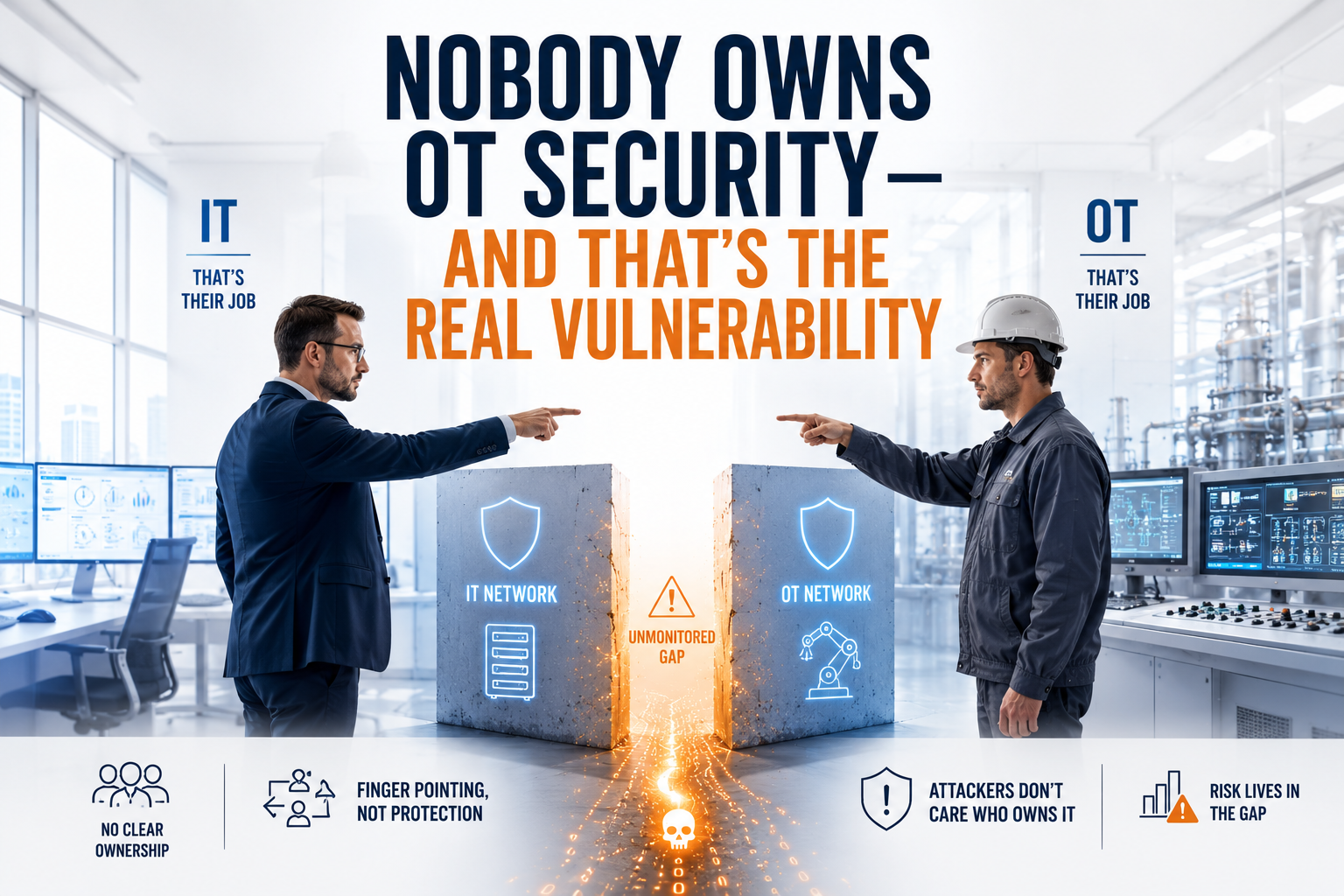
For most of its history, operational technology security was a plant-level concern — managed by engineering teams, governed by availability requirements, and largely invisible to corporate boards and executive leadership. The assumption was that OT environments were sufficiently isolated from IT networks and external threats to manage security as an operational discipline rather than an enterprise risk function.
That assumption no longer holds.
IT/OT convergence, driven by efficiency requirements, remote operations, predictive maintenance and digital integration across the supply chain, has created attack paths that connect corporate IT environments directly to industrial control systems. The isolation that once provided passive protection has been systematically eroded — often deliberately, for legitimate business reasons — without commensurate investment in the security controls that isolation previously made unnecessary.
The consequence is an attack surface that did not exist a decade ago and a threat landscape that has evolved to exploit it.
OT incidents can affect production, energy, safety, logistics, environmental outcomes and operational continuity. The organizations that understand this early — and build governance accordingly — will be better positioned when the incident happens. Because for most industrial organizations, it is a matter of when.
How the OT Threat Landscape Has Matured
The threat landscape for OT environments has undergone a fundamental transformation over the past five years. Understanding what has changed is prerequisite to understanding why the governance response must also change.
Criminal ransomware groups have developed OT capabilities. The groups conducting ransomware operations against industrial organizations are no longer simply IT attackers who accidentally affect OT systems. Leading ransomware groups have developed specific capabilities for OT environments — understanding that production downtime creates intense pressure to pay quickly and that the consequences of non-payment extend beyond data exposure to operational and safety impacts.
Nation-state actors have demonstrated willingness to use OT access as geopolitical leverage. Multiple incidents have demonstrated that sophisticated state-sponsored actors have pre-positioned access in critical infrastructure OT environments, not necessarily with immediate destructive intent but with the capability to cause significant harm at a time of geopolitical choice. The Colonial Pipeline incident demonstrated how IT-OT convergence can turn a conventional ransomware attack on IT infrastructure into an operational crisis requiring emergency shutdown of OT operations.
The attack surface has expanded with connectivity. Remote access for vendor maintenance, integration with enterprise ERP systems, cloud connectivity for operational analytics, and the proliferation of IoT sensors — each of these legitimate business capabilities has created additional attack paths into OT environments that were previously accessible only to personnel with physical presence.
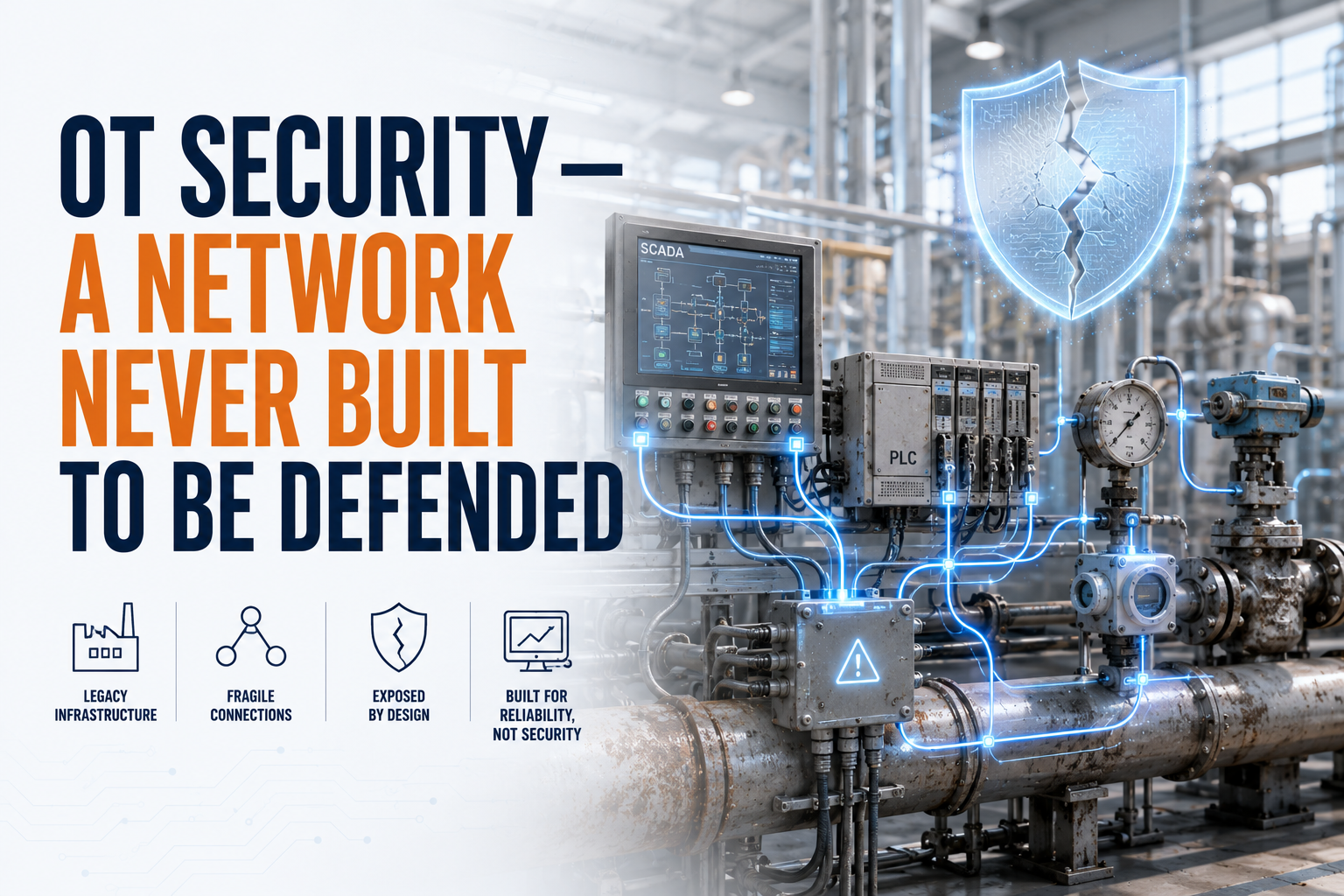
Legacy systems create structural vulnerability. OT environments contain equipment with operational lifespans measured in decades, often running operating systems and protocols that were designed without security as a consideration and that cannot be patched or updated without significant operational disruption. This legacy foundation cannot be rapidly modernized — it must be protected through compensating controls and architectural measures.
The Four Dimensions of OT Resilience
Building genuine OT resilience requires addressing four dimensions that are structurally interconnected — weakness in any one undermines the others.
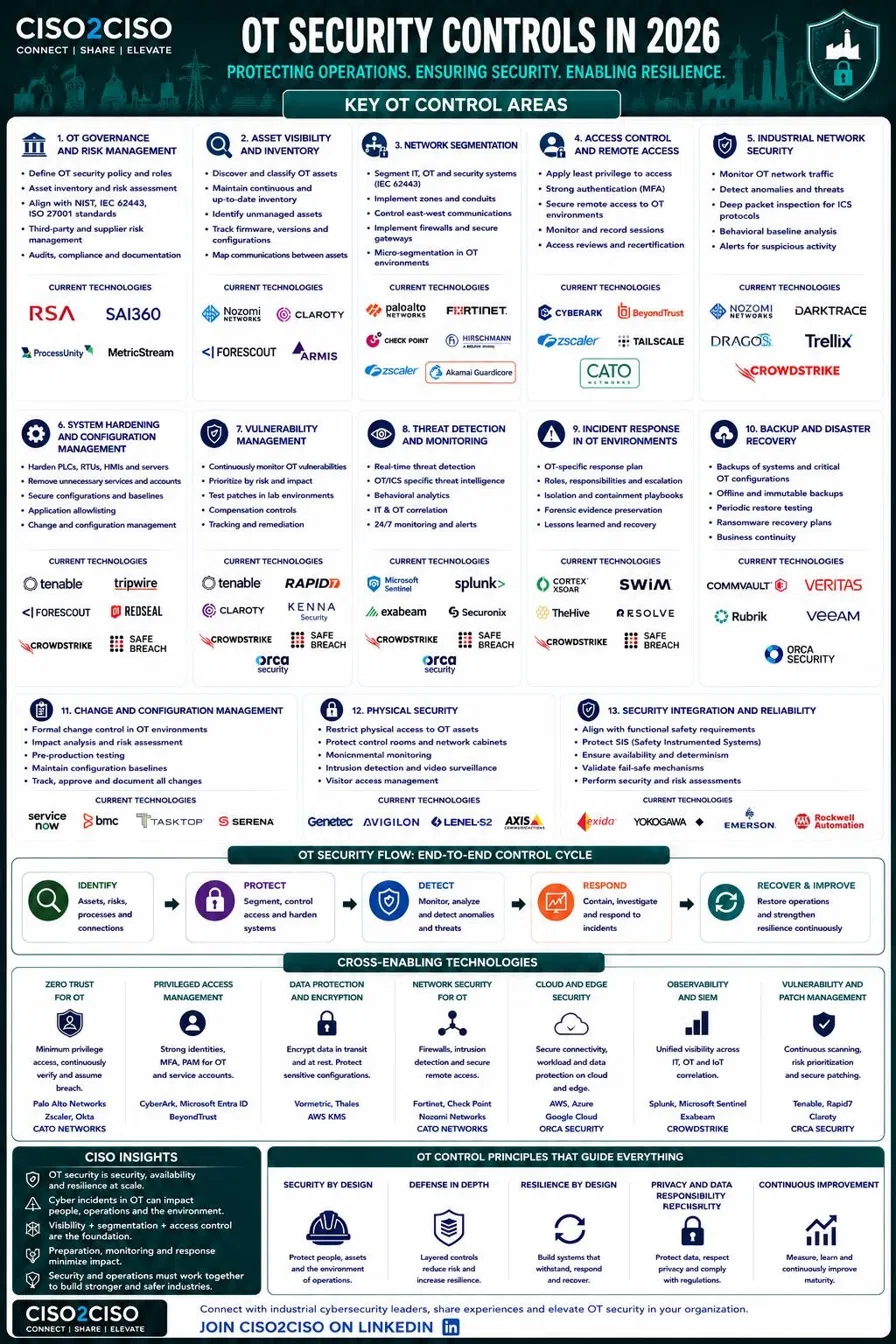
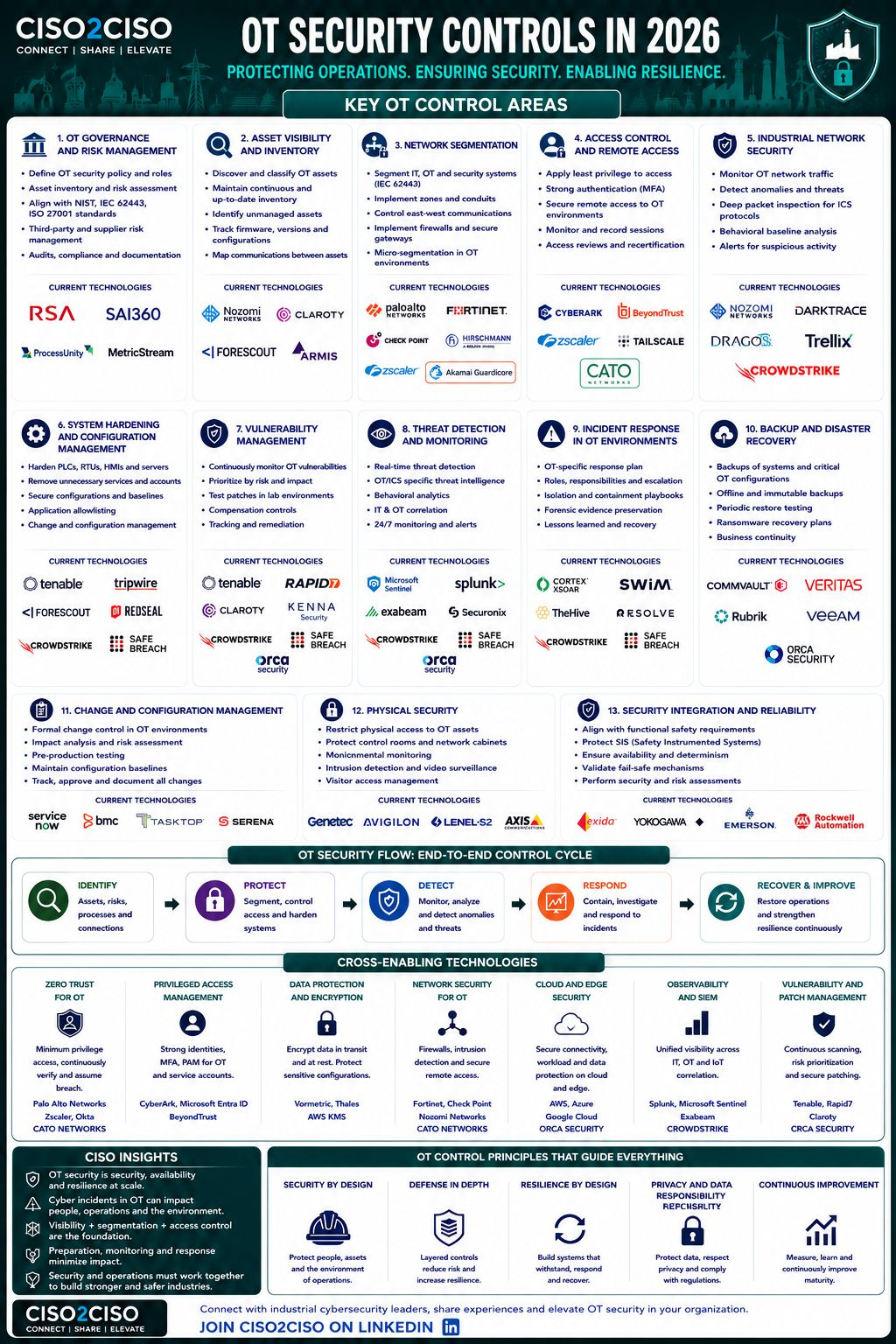
Visibility and asset inventory. The foundational requirement is knowing what is in the environment. OT asset inventories are consistently incomplete in most industrial organizations — legacy systems, undocumented connections, vendor-installed equipment, and devices added over decades without systematic cataloging create blind spots that prevent effective risk assessment and control implementation. Without visibility, governance is impossible. Passive asset discovery, network traffic monitoring and dependency mapping are the starting point for every OT security program.
Segmentation and network architecture. The flat network architectures that were acceptable when OT environments were physically isolated are not acceptable when those environments are connected to corporate IT networks, cloud services and vendor remote access. Segmentation between IT and OT networks, between different OT zones and process areas, and between vendor access and production systems is the primary architectural control for limiting lateral movement when an initial compromise occurs. Implementing proper segmentation in environments with legacy equipment and operational constraints requires careful planning — but it is not optional.
Secure remote access governance. Vendor and contractor remote access to OT environments is one of the highest-risk attack surfaces in industrial security. Every connection from an external party into an OT network is a potential attack path. The SolarWinds incident demonstrated how trusted vendor connectivity can be weaponized. Governing this access — scoped credentials with time-limited permissions, session monitoring and recording, approval workflows, and regular review of active access — is a governance requirement, not a technical nicety.
Incident response and recovery readiness. OT incident response is fundamentally different from IT incident response. Restoration of industrial processes has safety dimensions, vendor dependencies, spare parts requirements and restoration sequencing requirements that standard IT playbooks do not address. Organizations that have never tested OT recovery procedures against realistic scenarios are operating with unvalidated resilience assumptions. The gap between documented RTO and actual recovery capability in OT environments is consistently larger than organizations expect.
Executive Framework: OT Risk by Dimension
| OT Resilience Dimension | Business Consequence if Unaddressed | Governance Owner |
|---|---|---|
| Asset visibility gap | Unknown attack surface, ungovernable risk | CISO + Engineering |
| Flat IT/OT network | Unlimited lateral movement from IT compromise | CISO + IT + OT |
| Ungoverned remote access | Supply chain attack path to production systems | CISO + Procurement |
| Untested recovery | Unknown actual recovery time under real conditions | CISO + Operations |
| No executive governance | OT risk invisible to board decision-making | CEO + CISO + Board |
Regulatory Expectations Are Hardening
The regulatory environment for OT security in critical infrastructure is evolving rapidly. NIS2 in Europe, NERC CIP in the energy sector, IEC 62443 as an industrial security standard, and sector-specific requirements from regulators across healthcare, water, transportation and defense are creating accountability structures for OT security that were previously absent.
Board members and executives at critical infrastructure organizations face a regulatory environment that is actively scrutinizing OT governance. The question is no longer whether OT security will be subject to regulatory examination — it is whether the organization can demonstrate that its governance approach is adequate.
The organizations that are ahead of this have not waited for regulatory mandates to drive investment. They have recognized that the business risk of OT incidents — production loss, safety incidents, environmental liability and reputational damage — justifies investment in OT security governance independent of regulatory requirements.
What CISOs Should Do Now
Conduct an OT asset inventory. Commission a comprehensive discovery of OT assets, network connections and vendor access relationships. Include a mapping of IT/OT connection points — every location where IT and OT networks touch is a potential lateral movement path. This inventory is the prerequisite for every subsequent governance decision.
Assess and remediate segmentation. Map the current network architecture against what segmentation standards (such as IEC 62443 security levels or the Purdue Model) would require. Identify the highest-risk gaps — typically, IT/OT connections without inspection, flat OT networks with no zone separation, and vendor access without isolation — and develop a prioritized remediation roadmap.
Implement secure remote access controls. Audit all active vendor and contractor remote access connections. Remove or time-limit access that is not actively required. Implement session monitoring and recording for all remaining remote access. Establish an approval workflow for new remote access requests with security review.
Develop and test OT-specific incident response. Create OT incident response playbooks that account for the safety, operational and vendor dependency dimensions of OT recovery. Include tabletop exercises with operations leadership, and conduct at least annual testing of backup systems and recovery procedures — measuring actual recovery time against documented assumptions.
Present OT risk to the board in business terms. Translate OT risk into the language boards understand: production impact in days and revenue, safety incident scenarios and their financial and reputational consequences, regulatory exposure and liability, and the cost of the investment required to address the most critical gaps.
Board-Level Questions
- Do we have complete visibility into our OT assets and all connection points between IT and OT environments?
- Have we tested our OT incident response and recovery procedures against realistic scenarios — and do we know our actual recovery time, not our documented assumption?
- Is vendor and contractor remote access to our OT environments governed with approval workflows, session monitoring and regular access reviews?
- Does our board governance agenda explicitly include OT risk, with regular reporting on posture and progress?
- Are we aligned with IEC 62443, NIS2, NERC CIP or sector-specific regulatory requirements for OT security?
Final Takeaway
OT security has become a board-level issue because the consequences of OT incidents have become board-level consequences. Production disruption, safety incidents, environmental liability and the reputational damage of a significant OT event all require governance at the executive level.
The organizations that are ahead of this have made one fundamental decision: they have integrated OT security into enterprise cyber governance rather than leaving it in the operational technology domain where it has historically lived — and where it has historically been invisible to the people who need to make decisions about it.