The New Cyber Risk Conversation with Boards
Executive Summary
The board cyber conversation has undergone a quiet but fundamental shift over the past several years. Where boards once accepted — or expected — technical briefings about vulnerability counts, patch rates, and compliance scores, a growing number of boards are now asking something more demanding: what is the actual business exposure, how prepared are we to absorb a significant incident, and what decisions are we being asked to make?
This shift has been driven by a combination of forces. High-profile incidents at organizations that appeared to have strong compliance postures have eroded confidence in technical metrics as proxies for actual security. Regulatory changes — particularly the SEC's cybersecurity disclosure requirements — have given board members personal accountability for cyber governance that focuses attention in ways that voluntary oversight never did. And a generation of board members who have lived through significant cyber incidents at other organizations has accumulated direct experience of what the consequences actually look like.
The result is a new standard for board cyber communication — one that most security leaders are still catching up to. Understanding what that standard actually requires is the most important communication challenge facing CISOs today.
Why This Matters Now
The regulatory pressure on boards to demonstrate genuine cyber oversight — not just attendance at briefings — has intensified significantly. SEC rules require public companies to disclose material cybersecurity incidents within four business days and to provide annual disclosure of board oversight processes. European NIS2 requirements create personal liability for senior management in covered entities. These requirements have transformed board cyber engagement from a governance best practice into a fiduciary obligation.
The consequence for CISOs is significant. When board members carry personal accountability for cyber governance outcomes, they become more sophisticated consumers of cyber risk information — and more skeptical of reporting that creates the appearance of governance without the substance. A CISO who presents to a board that feels this accountability is presenting to an audience that is motivated to understand, not just to be reassured.
The boards that are most engaged in cyber governance are asking questions that most security reporting is not designed to answer. They are not asking about patch rates. They are asking about the scenarios that could materially disrupt the business, how confident leadership is in the organization's ability to detect and contain those scenarios, and what investment or governance decisions are required to close meaningful gaps. Answering these questions well is a qualitatively different challenge from producing a security dashboard.
CISO2CISO Insight
The CISO who walks into a board meeting with a red-amber-green dashboard is bringing the wrong document to the wrong conversation. Boards do not govern by color. They govern by decision — and giving them the information to make decisions is the entire job.
What the New Board Conversation Actually Requires
Scenario-based risk framing. The most effective board cyber presentations are organized around scenarios, not control categories. Not "here is the state of our vulnerability management program" but "here are the three scenarios that represent the highest potential business impact — what could happen, what our current capability to detect and contain it is, and what the likely business consequences would be if we were wrong." Scenarios translate cyber complexity into business consequence in a way that control category reporting fundamentally cannot.
Honest assessment of resilience, not just prevention. Boards understand that breaches happen. What they need to understand — and what most security reporting obscures — is whether the organization has the operational capability to limit the damage when prevention fails. Recovery time objectives that have been tested, incident response plans that have been exercised, backup architectures that have been validated — these are the evidence of resilience that boards can actually evaluate. Reporting that implies prevention is comprehensive while leaving resilience capability unexamined is a form of governance gap.
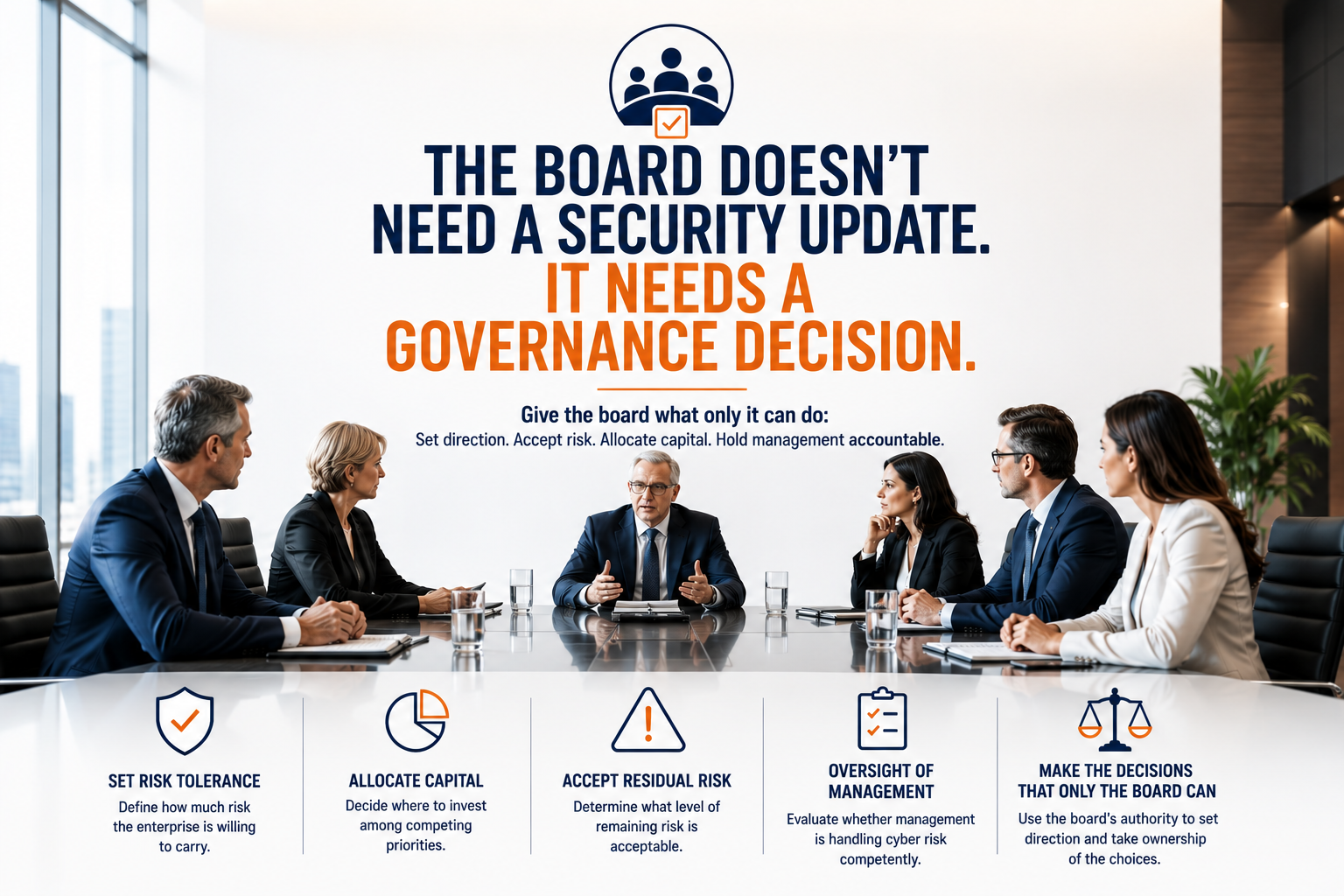
Investment decisions, not activity reports. Board governance requires decisions — about resource allocation, risk acceptance, policy, and priority. Security reporting that is organized as an activity report — here is what the security team has been doing — does not give boards the inputs they need to govern. Reporting organized around decisions — here are the risk gaps, here are the investment options, here are the trade-offs, and here is what we are recommending — is the format that enables genuine governance. CISOs who make this shift report that board engagement quality improves dramatically.
Quantified risk where possible. Qualitative risk ratings — high, medium, low — tell boards that something is a concern. Quantified risk estimates — the financial exposure range associated with a specific scenario — tell boards what the concern is worth in terms they use to make every other business decision. Full quantification is not always possible, and imprecise estimates are not useful. But developing ranges for the most material scenarios, even with wide confidence intervals, dramatically improves the governance value of cyber risk reporting.
Clear ownership and accountability. Every material risk presented to a board should have a clear answer to the question "who owns this?" Not the security team as a catch-all — but specific executives with accountability for the business processes, vendor relationships, or architectural decisions that create the risk. Boards govern through accountability structures, and cyber risk reporting that does not connect risk to ownership is missing the mechanism through which governance actually operates.
Executive Framework
| Board expectation | Typical reporting gap | What good looks like |
|---|---|---|
| Business impact clarity | Technical metrics without business translation | Scenario-based framing with consequence estimates |
| Resilience evidence | Prevention focus with no recovery assessment | Tested RTO/RPO and exercised IR plans |
| Decision inputs | Activity reports without options | Explicit investment options with trade-offs |
| Risk quantification | Qualitative RAG ratings | Financial exposure ranges for material scenarios |
| Accountability clarity | Security team as catch-all owner | Named executives for each material risk |
What CISOs Should Do Next
- Redesign your board presentation around three to five scenarios rather than control categories — and ensure each scenario includes a business consequence estimate.
- Include resilience evidence in every board report: what recovery capability has been tested, when, and what the results showed.
- Develop a risk quantification capability for your top five material risks — even rough financial ranges are more useful for governance decisions than qualitative ratings.
- Replace activity metrics with decision-oriented reporting: for each agenda item, be explicit about what decision or acknowledgment you are asking the board to make.
- Brief individual board members between formal meetings — the quality of board engagement is dramatically higher when members come to a meeting with context rather than encountering the material cold.
- Align your board reporting timeline with audit committee cycles — cyber risk should be a regular agenda item with defined governance touchpoints, not an ad hoc briefing when something goes wrong.
Board-Level Questions
- Is our cyber risk reporting giving us the information we need to make governance decisions, or is it primarily an activity report?
- Do we understand the three to five scenarios that represent the highest potential business impact — and what our current capability to detect and contain them is?
- Have we tested our resilience assumptions — recovery times, backup integrity, incident response capability — against realistic scenarios?
- For each material cyber risk, is there a named executive accountable for managing it?
Final Executive Takeaway
The board cyber conversation has become a genuine governance conversation — not a technical briefing, not a compliance update, but a substantive discussion about material business risk and the decisions required to manage it. CISOs who make the transition to this kind of communication — scenario-based, decision-oriented, quantified where possible, and organized around accountability — consistently report that board relationships and budget outcomes improve.
Those who have not made the transition are providing governance theater: presentations that give the appearance of board oversight without enabling the substance of it. In an environment where boards carry personal accountability for cyber governance outcomes, that gap is increasingly visible — and increasingly consequential.
The most important question a CISO can ask before a board presentation is not "have I covered all the key topics?" It is "at the end of this presentation, what decision will the board be in a better position to make?"