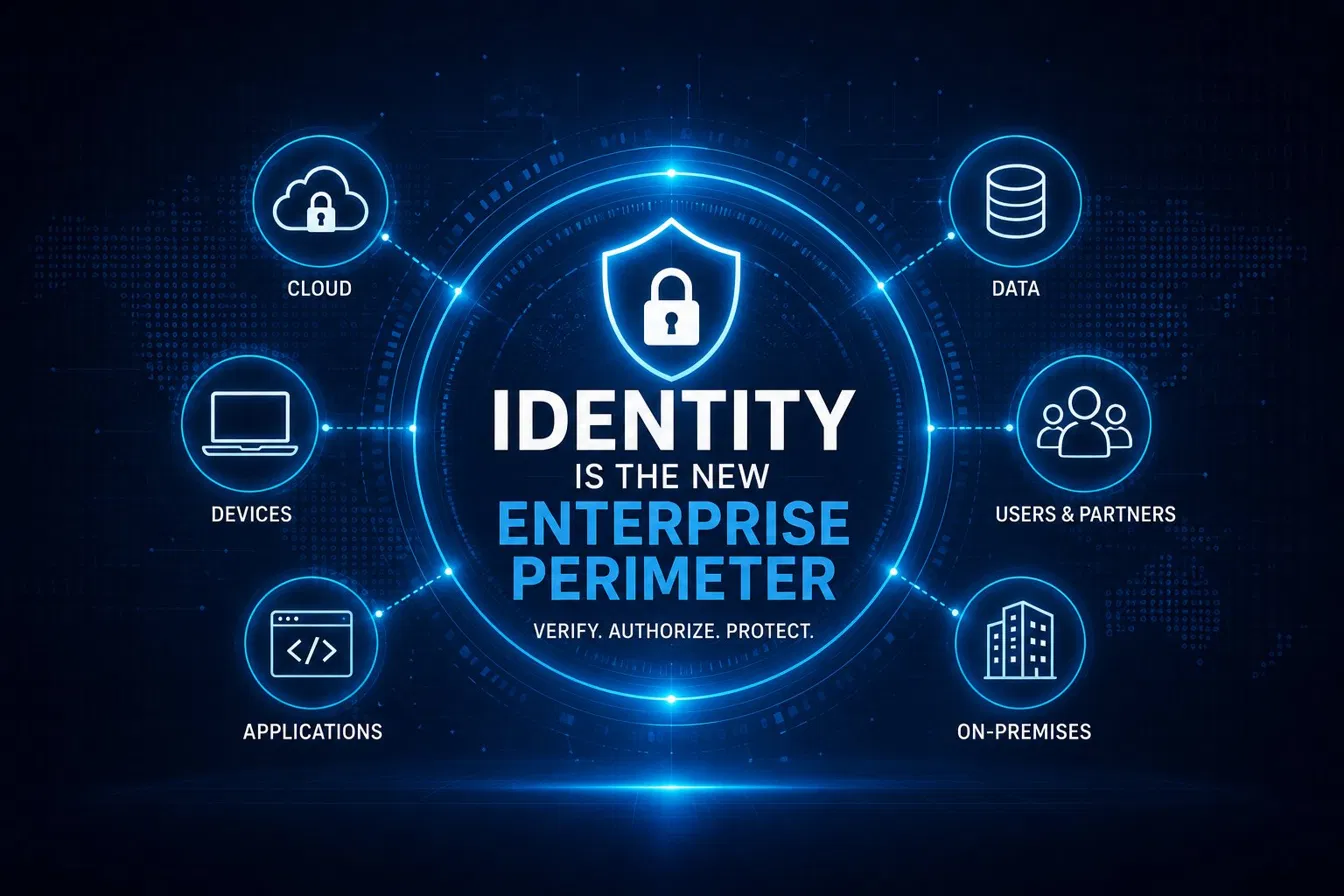
Identity Is the New Enterprise Perimeter
Executive Summary
For thirty years, enterprise security was organized around a simple spatial metaphor: inside and outside. The firewall was the wall. The network was the trusted zone. Everything inside was assumed legitimate, and security energy focused on keeping threats from crossing the boundary.
That model is gone. Not weakened — gone. Cloud infrastructure has no inside. SaaS applications live outside any perimeter. Remote work eliminated the assumption that physical presence correlates with trust. Mobile devices, vendor connections, API integrations, and AI agents have created a distributed operating environment where the concept of a network boundary has ceased to be a meaningful security construct.
What has replaced it is identity. Every meaningful security decision in a modern enterprise — who can access what, from where, under what conditions, with what level of privilege — is now an identity decision. The organizations that have internalized this shift and rebuilt their security architecture around it are operating with a fundamentally sounder model than those still optimizing perimeter controls for an environment that no longer exists.
Why This Matters Now
The identity attack surface has expanded in ways that most organizations have not fully registered. It is no longer just about employees logging in with passwords. Identity now encompasses service accounts, API keys, OAuth tokens, certificates, workload identities in cloud environments, machine-to-machine authentication across microservices, and — increasingly — the delegated authority of AI agents acting autonomously on behalf of users and systems.
The consequence is that identity has become the primary attack vector for the most significant breaches of the past several years. Credential compromise, privilege escalation, token theft, and the abuse of over-permissioned service accounts are the dominant patterns in attacks on cloud environments. Supply chain attacks succeed in large part because of trusted identity relationships — attackers who compromise a vendor's credentials inherit the trust that the enterprise has granted to that vendor.
The specific identity risks that matter most right now are not the ones most organizations are focused on. They are not about password complexity or MFA enrollment rates. They are about the silent accumulation of identity debt: the thousands of service accounts with excessive permissions, the OAuth applications granted broad access years ago and never reviewed, the privileged identities that exist in cloud environments without the governance that would apply to equivalent on-premises accounts, and the non-human identities — machine accounts, API keys, agent credentials — that have collectively acquired enormous operational authority with almost no governance structure.
CISO2CISO Insight
The most dangerous identities in most enterprise environments are not the ones attackers create. They are the ones organizations created themselves, over-privileged, under-monitored, and long forgotten — waiting to be discovered and exploited.
The Five Dimensions of Modern Identity Risk
Human identity governance. The foundation — but the governance rigor applied to human identities has typically focused on provisioning and deprovisioning while neglecting the ongoing question of whether access rights remain appropriate as roles change. Joiner-mover-leaver processes address the lifecycle endpoints. The accumulation of excessive access in the middle of a career is rarely captured. Regular access certification — not as a compliance exercise but as a genuine governance mechanism — is the discipline that catches this drift.
Privileged access management. Privileged identities represent the highest-value targets in any enterprise environment. Administrator accounts, root credentials, privileged service accounts, and elevated cloud IAM roles are the keys to everything that matters. The governance of privileged access — just-in-time provisioning, session recording, approval workflows, and regular privilege review — is the area where identity governance investment has the highest security return per dollar. And it is consistently the area where the gap between policy and practice is widest.
Machine and workload identity. Cloud-native architectures have created an explosion of non-human identities: service accounts for every application, IAM roles for every workload, API keys for every integration. These identities are often provisioned with broad permissions to avoid access errors during development, and then left in production with those broad permissions indefinitely. Unlike human accounts, they are not subject to regular access review, they do not expire, and their activity is rarely monitored with the same rigor applied to human accounts. They are the silent attack surface that most identity governance programs have not yet addressed.
Third-party and supply chain identity. Vendor and partner access represents one of the highest-risk identity categories in most enterprises — access granted to external parties who operate largely outside the organization's visibility. The governance of external identities — who has access, to what, for how long, with what monitoring — is dramatically underinvested relative to its risk contribution. Every significant supply chain attack in recent years has exploited trusted third-party identity relationships.
AI agent identity. The newest and most rapidly growing identity category. AI agents are being granted access to enterprise systems, data, and APIs with an urgency that has outrun governance development. The question of how to govern delegated authority for autonomous agents — what they can access, what actions they can take, how those actions are audited — is the identity governance challenge of the next several years. Organizations that establish these governance frameworks now will be significantly better positioned than those that build governance retroactively after incidents.
Executive Framework
| Identity category | Primary risk | Governance priority |
|---|---|---|
| Human identities | Access accumulation and credential compromise | Regular certification and strong authentication |
| Privileged accounts | High-value target for escalation | Just-in-time access and session accountability |
| Machine and workload identities | Over-permission and no monitoring | Inventory, scoping, and behavioral monitoring |
| Third-party identities | Supply chain attack paths | Scoped access and continuous monitoring |
| AI agent identities | Ungoverned delegated authority | Policy framework and action logging |
What CISOs Should Do Next
- Commission a non-human identity inventory: map every service account, API key, OAuth grant, and workload identity in your environment — you will almost certainly find significant surprises in scope and permissions.
- Implement regular access certification for privileged accounts that goes beyond provisioning review — assess whether current access levels are still appropriate for current roles.
- Apply least-privilege principles to your cloud IAM configurations with the same rigor you apply to on-premises privileged access — the default over-permission of cloud service accounts is one of the most exploited vulnerabilities in enterprise cloud environments.
- Establish a governance framework for third-party identity before your next vendor relationship — not as a retroactive exercise but as a standard component of vendor onboarding.
- Develop your AI agent identity governance policy now, before the governance gap becomes a governance crisis — define what AI agents can and cannot access, how their actions are logged, and who is accountable for their behavior.
- Measure identity risk in terms that boards can understand: concentration of privileged access, percentage of non-human identities with governance coverage, third-party access with active monitoring.
Board-Level Questions
- Do we have comprehensive visibility into every identity — human, machine, and AI agent — that has access to our most sensitive systems?
- When did we last review whether our most privileged accounts have appropriate permissions, and what was the finding?
- Are we governing the identity of AI agents and automated systems with the same rigor we apply to privileged human accounts?
- If an external vendor's credentials were compromised tonight, what could an attacker reach in our environment — and how quickly would we know?
Final Executive Takeaway
Identity governance is not a compliance function. It is the operating discipline that determines whether your security architecture actually controls access in practice or only on paper. The identity posture of most enterprises — with its over-privileged service accounts, ungoverned API tokens, under-monitored vendor access, and emerging AI agent authority — represents a risk surface that is simultaneously significant and largely invisible to standard security reporting.
The organizations that are taking identity seriously as the new perimeter are doing something fundamental: they are treating every access decision — human, machine, and agent — as a security decision that requires governance, monitoring, and accountability.
The question is not whether identity is the new perimeter. It is whether your identity governance is actually fit for the environment you are operating in — or whether it was designed for a perimeter that no longer exists.