Executive Lessons from Recent Ransomware Cases
Executive Summary
The pattern that emerges from analyzing significant ransomware incidents is consistent enough to be instructive: the technical mechanism of the breach — the initial access vector, the ransomware variant deployed — is rarely the primary determinant of business impact. What determines impact is the organizational response: how quickly the scope was understood, how decisively containment decisions were made, how well the recovery architecture worked in practice, and how effectively the organization communicated under conditions of extreme pressure.
This is not a comfortable conclusion for organizations that have focused primarily on preventive technical controls as their ransomware defense. Prevention matters — reducing the probability and the blast radius of incidents is genuine value. But the evidence from significant ransomware incidents is that organizations with strong preventive controls still get hit, and the difference between a contained incident and a catastrophic one is increasingly determined by operational and organizational factors that most security programs have not fully addressed.
The lessons that follow are drawn from the pattern of significant incidents across sectors over the past several years. They are not company-specific — but they are specific enough to be actionable.
Why This Matters Now
Ransomware has evolved from a commodity threat into a sophisticated criminal enterprise with capabilities that rival nation-state threat actors in some respects. Modern ransomware operators conduct reconnaissance before deploying ransomware — understanding the target's backup architecture, identifying the most critical systems, and timing deployment for maximum impact. They exfiltrate sensitive data before encryption, creating a second extortion lever that persists even after successful recovery. And they increasingly target the operational technology environments and critical infrastructure that organizations depend on most.
The consequence is that the scenarios organizations need to prepare for are significantly more complex than the early ransomware playbooks addressed. Recovery from a modern ransomware incident that includes data exfiltration, OT impact, and third-party notification obligations is a multi-week organizational challenge, not a multi-day technical recovery exercise. Planning and preparing for that challenge requires executive engagement, cross-functional coordination, and a level of operational readiness that most organizations have not tested.
CISO2CISO Insight
The ransomware plan that has never been tested is not a plan. It is a theory about what the organization will do under conditions it has never experienced. The gap between the plan and the reality is usually discovered during the incident — at the worst possible time.
Five Lessons That Repeat Across Incidents
Lesson one: Decision authority needs to be pre-established, not improvised. One of the most consistent findings from post-incident analyses is the decision-making paralysis that occurs when organizational authority structures have not been pre-established for the specific decisions a ransomware incident requires. Who has authority to take critical systems offline — including revenue-generating systems — without waiting for committee approval? Who has authority to engage an external incident response firm and commit the associated costs? Who has authority to communicate externally — to customers, regulators, and media — and what is the communication approval process when normal channels are unavailable? These decisions cannot wait for committee formation under incident conditions. They need to be pre-approved, documented, and rehearsed.
Lesson two: Backup architectures fail in practice more often than in theory. The single most operationally damaging discovery in many ransomware incidents is that the backup architecture, which appeared sound in design and documentation, does not work as expected when recovery is attempted. Backups that were corrupted before the incident was detected. Recovery procedures that had not been executed for months and contained undocumented dependencies. Restoration times that were vastly longer than documented because the procedure was designed for individual system recovery, not enterprise-scale restoration. Recovery Time Objectives that were determined by business requirements but were not connected to validated technical capabilities. The gap between backup architecture as designed and backup architecture as it actually performs under incident conditions is one of the highest-value items for pre-incident investment and testing.
Lesson three: The blast radius is determined before the incident, not during it. The extent of systems affected in a ransomware incident is largely determined by architectural decisions made before the incident: network segmentation between critical and non-critical systems, identity architecture that limits lateral movement from compromised accounts, the connectivity between IT and OT environments, and the privilege levels of accounts that are available to attackers after initial access. Organizations that have invested in limiting lateral movement opportunities — through network segmentation, least-privilege identity architecture, and privileged access management — consistently experience more contained incidents than those with flat network architectures and over-privileged accounts. This investment cannot be made during an incident. It must be made before one.
Lesson four: External communication shapes outcomes as much as technical response. The communication dimension of ransomware response — to customers, employees, regulators, media, and the public — is consistently underplanned relative to its impact on the organization's ultimate recovery. Organizations that communicate promptly, transparently, and with clear information about what is known and what is not known maintain more customer trust and regulatory goodwill than organizations that delay communication while attempting to understand the full scope of the incident. The regulatory notification obligations — particularly the SEC's four-day disclosure requirement for material incidents and GDPR's 72-hour notification requirement — have made communication planning a compliance requirement, not just a reputation management consideration.
Lesson five: Recovery operations require a different organizational posture than normal operations. The operational demands of incident response and recovery — maintaining business continuity on degraded systems, coordinating dozens of workstreams across technical and business functions, managing external communication with multiple stakeholders, making high-stakes decisions with incomplete information under extreme time pressure — require organizational capabilities that are not developed or exercised in normal operations. The organizations that recover most effectively are those that have built and rehearsed the specific organizational muscle that incident response requires, not those with the most sophisticated security technology.
Executive Framework
| Lesson | Pre-incident investment | Post-incident consequence of gap |
|---|---|---|
| Decision authority | Pre-approved authority matrix | Paralysis at critical decision points |
| Backup validation | Regular tested recovery exercises | Discovered failures during recovery |
| Blast radius architecture | Segmentation and least privilege | Extensive lateral movement |
| Communication preparation | Pre-drafted templates and authority | Regulatory penalties, reputational damage |
| Recovery organizational posture | Tabletop and full exercises | Coordination failure under pressure |
What CISOs Should Do Next
- Establish a pre-approved incident decision authority matrix: for each major category of decision that a ransomware incident requires, document who has authority to make it without escalation, and communicate that matrix to all relevant executives.
- Test your backup and recovery architecture under realistic conditions: full restoration exercises for critical systems, documenting actual restoration times against RTOs and RPOs.
- Commission a lateral movement analysis of your highest-risk environments: understand what an attacker with compromised credentials in your environment can reach, and close the paths that lead to your most critical systems.
- Develop pre-drafted communication templates for ransomware scenarios: customer notification, regulatory notification, employee communication, and media statements should exist in draft form before they are needed.
- Run a tabletop exercise that specifically tests organizational decision-making under incident conditions — focusing not on technical response but on the authority, communication, and coordination challenges that incident response creates.
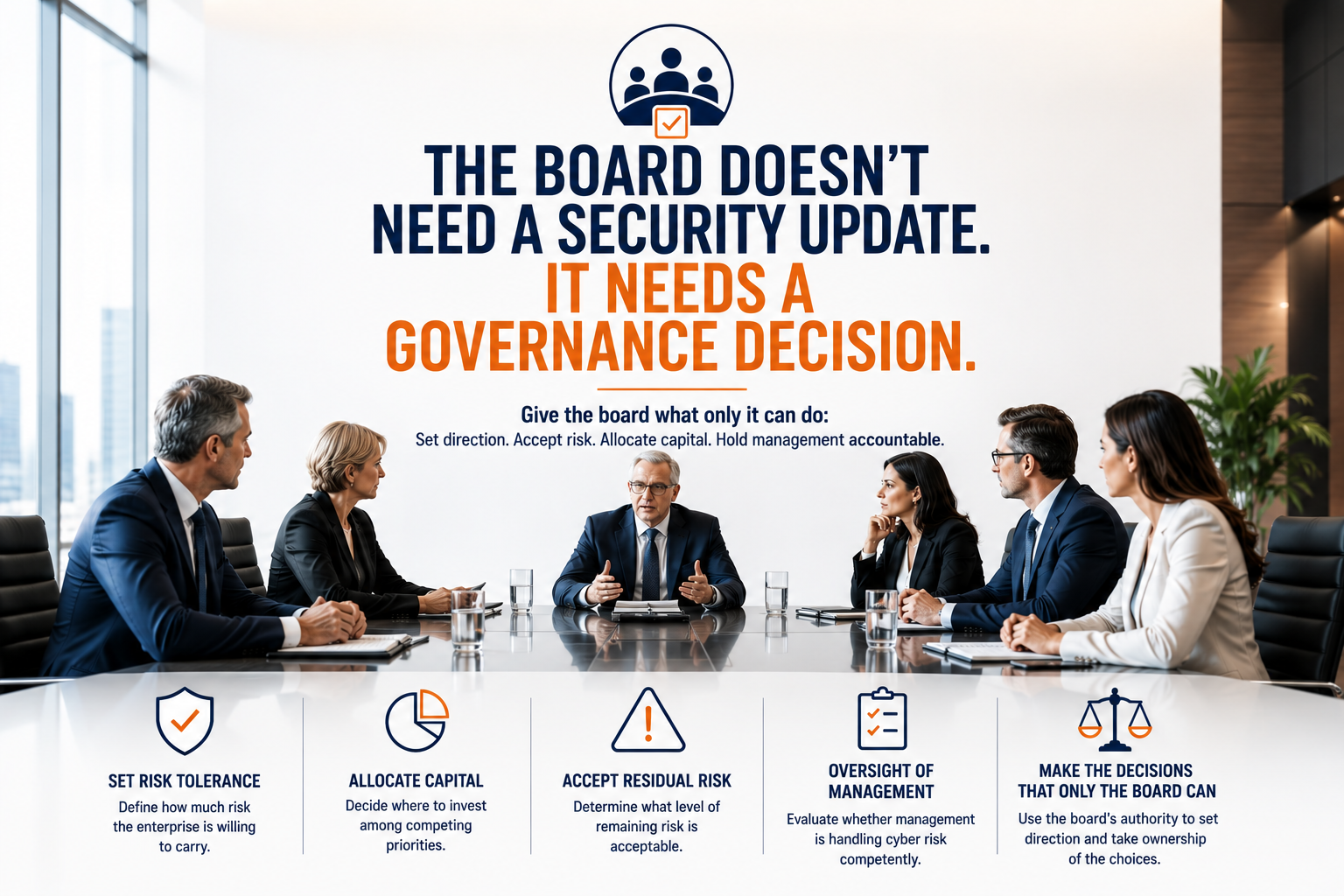
- Review your ransomware insurance coverage against the five lessons above: the gap between what your policy covers and what your actual incident costs would be is a governance conversation for the board.
Board-Level Questions
- Have we tested our backup and recovery architecture against realistic ransomware scenarios — and do we know our actual restoration capabilities, not our designed ones?
- Does our organization have pre-established decision authority for the major decisions that a ransomware incident requires — including authority to take revenue-generating systems offline?
- Are we prepared for the communication obligations a significant ransomware incident would create — including regulatory notification timelines?
- Has our leadership team rehearsed the organizational experience of ransomware response — not the technical response, but the decision-making, communication, and coordination under pressure?
Final Executive Takeaway
Ransomware readiness is an organizational capability, not a technical configuration. The organizations that perform best in significant ransomware incidents are not necessarily the ones with the most sophisticated security technology — they are the ones that have invested in the organizational infrastructure of response: pre-established decision authority, tested recovery capabilities, pre-prepared communications, and practiced coordination.
The investments required to build this capability are not primarily security investments. They are organizational investments — in planning, in rehearsal, in cross-functional coordination, and in the kind of honest assessment of gaps that requires both the security function and business leadership to confront uncomfortable questions about resilience assumptions.
The ransomware question that every executive team should be able to answer is not "are we protected?" — it is "if we were hit tonight, would our organization actually be able to respond effectively? And how do we know?"