API Security Is Becoming an Enterprise Risk Layer
Executive Summary
There is a version of enterprise security that has strong perimeter controls, mature identity governance, sophisticated endpoint detection, and a well-resourced SOC — and still suffers a significant breach through an API that nobody in the security team knew existed. This scenario is not hypothetical. It describes a substantial percentage of the significant data breaches of the past several years.
APIs have become the primary mechanism through which modern enterprises operate: they connect customers to products, partners to platforms, cloud services to business processes, AI systems to enterprise data, and operational systems to analytics infrastructure. Every major SaaS platform exposes APIs. Every cloud service is consumed through APIs. Every mobile application communicates through APIs. The average enterprise API inventory runs into the thousands, and the growth rate of that inventory has consistently outpaced the governance infrastructure designed to manage it.
The result is a risk surface that is simultaneously enormous, poorly understood, and directly connected to the most sensitive data and critical functions of the enterprise. API security has become a board-level concern not because the technology has changed — APIs have been a security concern for years — but because the business dependency on APIs has grown to the point where API risk is enterprise risk.
Why This Matters Now
The breach pattern is now well-established. API attacks do not look like traditional intrusions. They do not typically involve malware, lateral movement, or the indicators that security operations teams are trained to identify. They look like valid API traffic — legitimate requests using legitimate credentials — because the attacker has either compromised credentials, found an authorization flaw, or discovered an API that provides access it was never intended to provide.
The OWASP API Security Top 10 — which reads as a catalog of real-world breach patterns — is dominated by authorization failures rather than authentication failures. Broken object-level authorization, broken function-level authorization, and excessive data exposure are the attack patterns that have produced the largest API-related breaches. These are not sophisticated zero-days. They are design and governance failures: APIs that were built to do one thing but can be manipulated to do another, or APIs that return more data than the application needs and that attackers can exploit to extract information at scale.
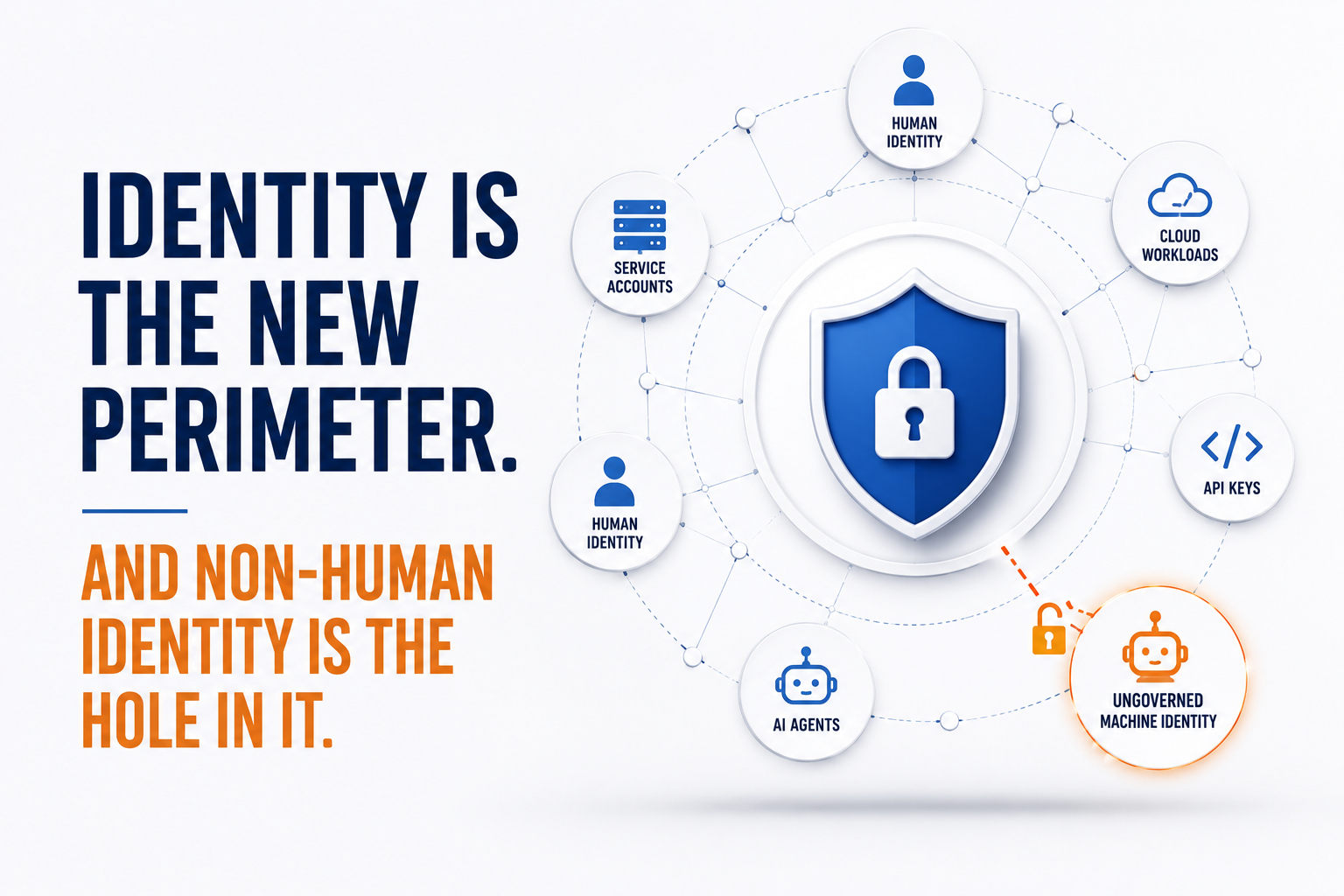
The AI dimension has added urgency. AI agents — whether deployed by the enterprise or by attackers — interact with enterprise systems primarily through APIs. An AI agent authorized to read calendar data that also has access to email, contacts, and file systems through the same API credentials represents exactly the kind of authorization scope creep that API security governance is designed to prevent. As AI agent deployment accelerates, the quality of API authorization governance becomes directly relevant to AI security.
CISO2CISO Insight
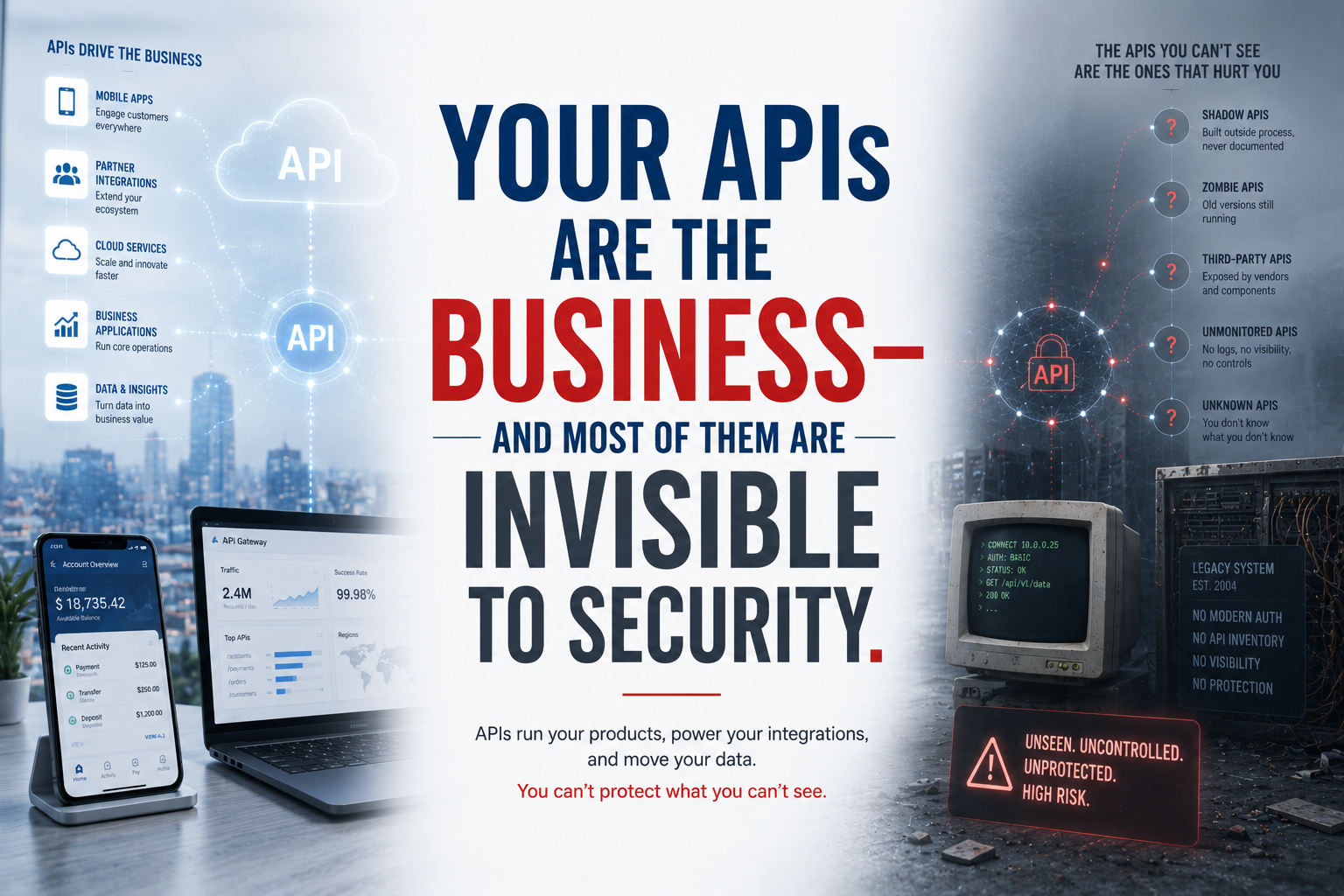
Most enterprises know roughly what their perimeter looks like. Very few know what their full API surface looks like — including the APIs created by development teams, exposed by SaaS vendors, or generated by cloud services. You cannot govern what you cannot see, and most organizations cannot see their API surface.
The Four API Risk Dimensions That Matter Most
Discovery and inventory. The foundation of API security governance is knowing what APIs exist. This is more difficult than it sounds. APIs are created by development teams on development timelines, exposed by SaaS vendors through their platform architectures, generated by cloud services as part of their operation, and created by legacy systems that have been exposing interfaces for years without systematic documentation. The gap between the APIs an organization knows about and the APIs that are actually operating in its environment is consistently significant — and it is in the undocumented APIs where the highest-risk exposures tend to live.
Authorization architecture. Authentication — verifying that a caller is who they claim to be — is the part of API security that most organizations have addressed reasonably well. Authorization — verifying that an authenticated caller is permitted to perform the specific action they are attempting on the specific resource they are targeting — is where most API security programs fall short. Object-level authorization requires that every API endpoint validates not just that the caller is authenticated, but that the authenticated caller has permission to access the specific data object being requested. Function-level authorization requires that elevated operations — administrative functions, bulk data operations, privileged data access — are restricted to callers that explicitly require them. These are design disciplines that must be built into API development processes, not security controls that can be bolted on afterward.
Business logic and behavioral baseline. Some of the most damaging API attacks exploit not technical vulnerabilities but business logic: they make API calls that are technically valid but operationally anomalous. Scraping customer data by making thousands of individually valid read requests. Bypassing rate limits by distributing requests across multiple credentials. Exploiting the gap between what an API is designed to do and what it is technically capable of doing. Detecting these attacks requires a behavioral baseline — an understanding of what normal API traffic looks like for each endpoint — against which anomalies can be identified. Building this baseline is a security operations discipline, not a development discipline.
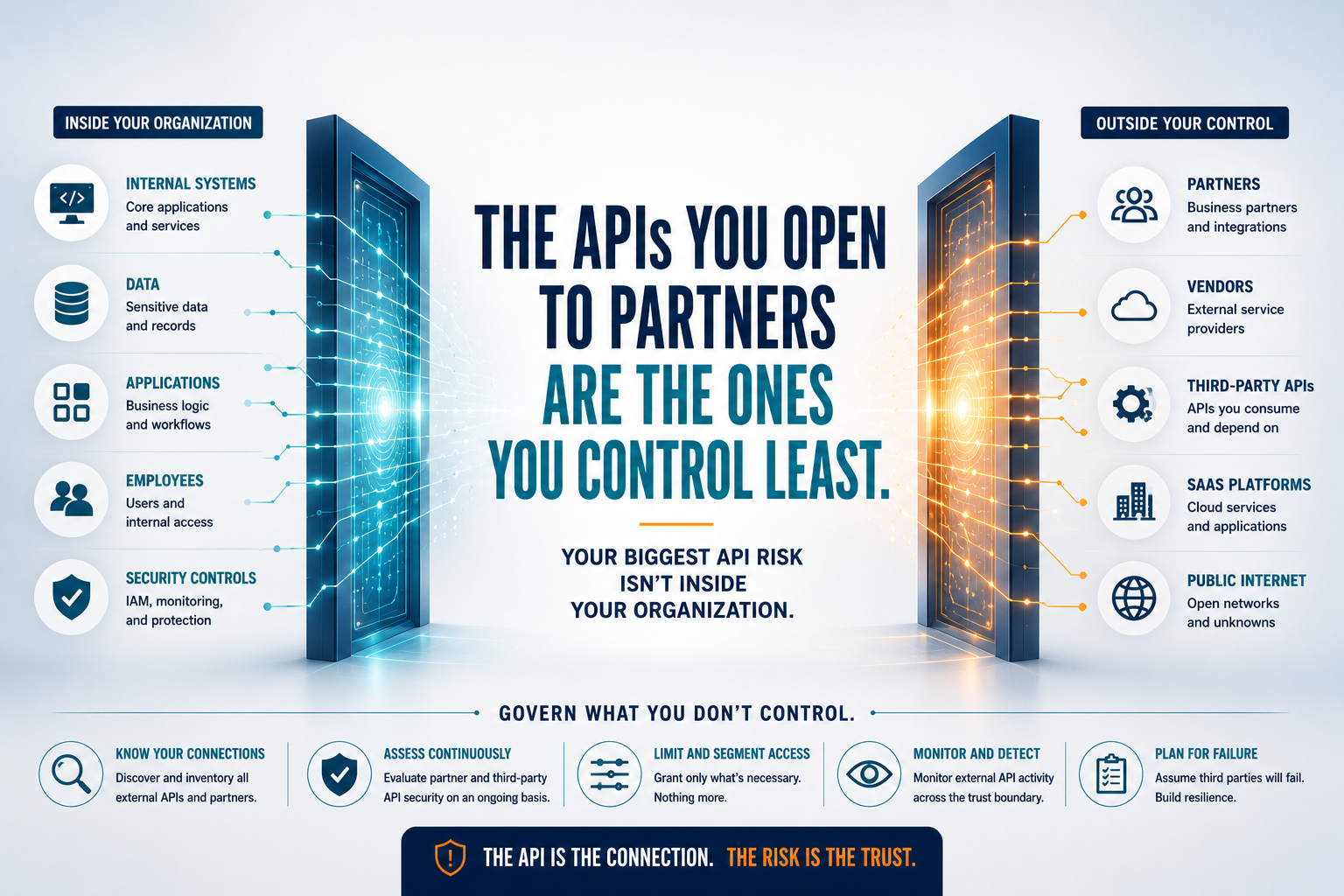
Third-party and partner API governance. The APIs that connect the enterprise to its vendors, partners, and customers represent a distinct governance challenge. Third-party APIs that the enterprise consumes carry supply chain risk — the security of those APIs depends on the security practices of the provider. APIs that the enterprise exposes to partners and customers carry data exposure and business logic risk that requires governance structures equivalent to the internal API governance described above, but implemented in environments where the enterprise has less control over how the APIs are used. The contractual and technical governance of API-based third-party relationships is one of the most consistently underinvested areas of enterprise API security.
Executive Framework
| API risk category | Primary risk | Governance requirement |
|---|---|---|
| Unknown APIs | Unmonitored attack surface | Continuous discovery across all environments |
| Authorization failures | Data exposure and privilege escalation | Object and function-level authorization by design |
| Business logic abuse | Anomalous usage at scale | Behavioral baseline and anomaly detection |
| Third-party APIs consumed | Supply chain exposure | Vendor API security assessment |
| APIs exposed to partners | Data exposure and abuse | API gateway governance and usage monitoring |
| AI agent API access | Scope creep and unauthorized access | Scoped credentials and action logging |
What CISOs Should Do Next
- Commission an API discovery exercise across all environments — cloud, on-premises, and SaaS — to establish an accurate inventory, including APIs created by development teams, exposed by vendors, and generated by cloud services.
- Evaluate your API authorization architecture against the OWASP API Security Top 10: specifically, whether object-level and function-level authorization are implemented consistently across your API surface.
- Establish behavioral monitoring for your highest-risk API endpoints — the ones that provide access to sensitive data or critical functions — with anomaly detection that can identify business logic abuse.
- Include API security requirements in your software development lifecycle: authorization design, credential scoping, and logging requirements should be explicit development standards, not post-deployment security reviews.
- Assess the API governance of your most critical third-party relationships: what APIs are you consuming, what data do they access, and what evidence do you have of their security posture?
- Map your AI agent API access: for every AI agent or automation that uses enterprise APIs, what is the scope of its credentials, what actions can it initiate, and how is that access monitored?
Board-Level Questions
- Do we have a comprehensive inventory of our API surface, including APIs created by development teams and exposed by third-party vendors?
- What is our current authorization architecture for APIs that provide access to our most sensitive data, and has it been independently assessed?
- Are we monitoring API traffic for behavioral anomalies — patterns that are technically valid but operationally abnormal?
- How are we governing the API access of AI agents and automated systems that interact with enterprise data and functions?
Final Executive Takeaway
API security has become enterprise risk because APIs have become enterprise infrastructure — the mechanisms through which virtually every critical business function, data flow, and external relationship operates. Treating API security as a development concern rather than an enterprise risk concern is a category error that is becoming increasingly costly.
The organizations that have elevated API security to the enterprise governance level — with discovery, authorization governance, behavioral monitoring, and third-party API oversight — are discovering that the discipline is less exotic than it sounds. It is, at its core, the application of the same governance principles that apply to any critical enterprise interface: know what exists, control who can access it and what they can do, monitor how it is being used, and hold someone accountable for each.
The question every CISO should be asking is not whether their APIs are documented — it is whether their API surface is actually governed, whether authorization is actually enforced, and whether anomalous usage would actually be detected.