AI Security Is Becoming an Executive Function
Executive Summary
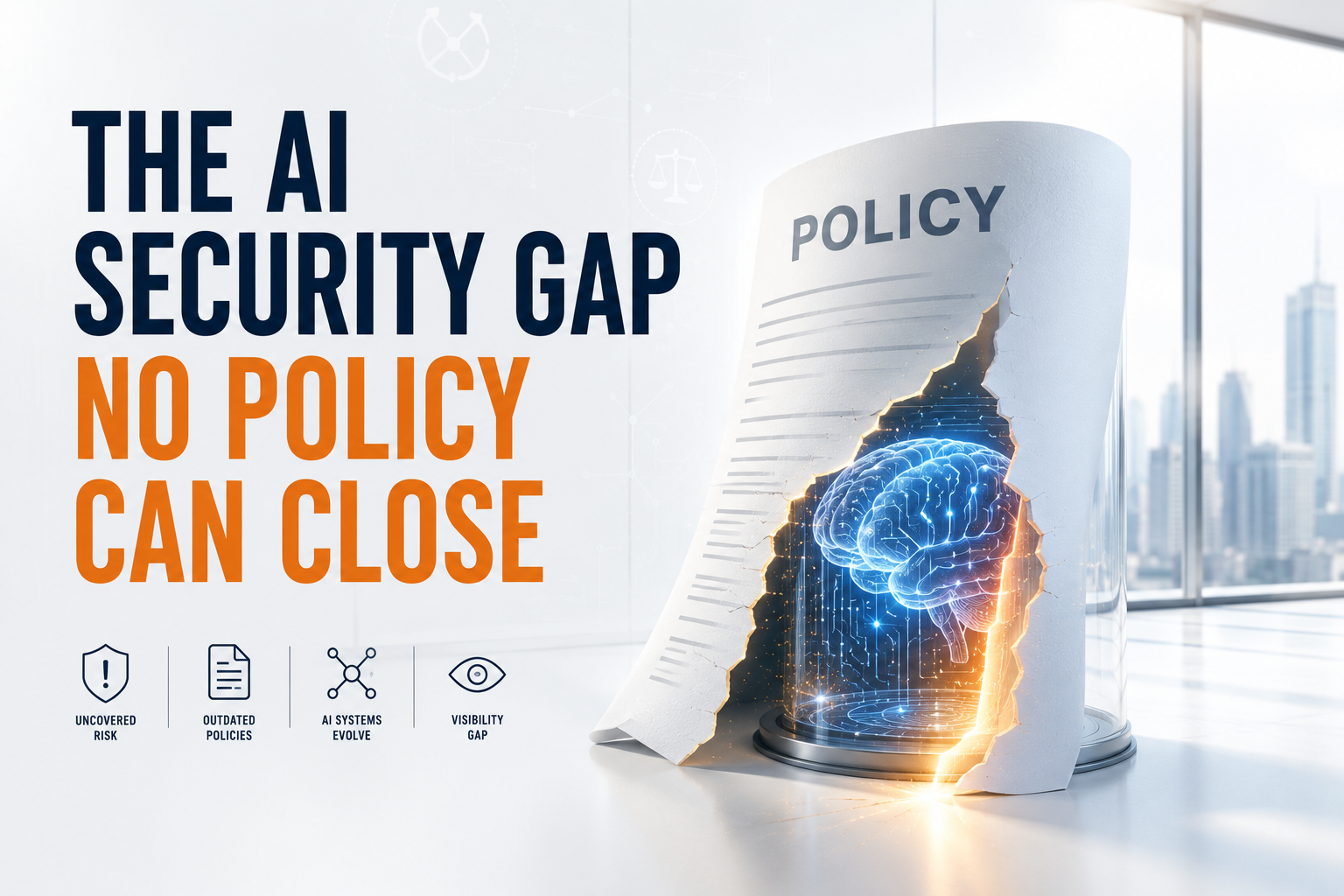
There is a version of AI security governance that looks functional from the outside: an AI policy exists, there is an AI governance committee, the acceptable use guidelines have been communicated to employees, and the security team has been asked to assess AI tool risks before procurement. The box is checked. The governance is documented.
And then a business unit deploys an AI agent with broad enterprise access without security review because the procurement process did not cover internally built tools. Or a customer-facing AI feature is launched with training data that includes sensitive customer information because the data team and the security team were not in the same conversation. Or the legal team discovers that the organization's AI usage creates regulatory exposure under the EU AI Act in ways that nobody had mapped because the relevant expertise was distributed across functions that were not coordinating.
These scenarios are not hypothetical. They are the predictable consequence of treating AI security as a department-level technical responsibility when the actual risk is cross-functional, the decisions are consequential at the enterprise level, and the governance requires executive coordination that department-level authority cannot provide.
Why This Matters Now
Three forces have converged to make AI security an executive function in 2026.
The regulatory environment has created personal accountability. The EU AI Act, SEC AI disclosure guidance, and a growing body of sector-specific AI regulatory requirements have created a compliance landscape where the board and C-suite carry personal accountability for AI governance decisions. This accountability cannot be delegated to the security team or the compliance team — it belongs at the executive level, and meeting it requires executive-level engagement with AI security governance.
The business stakes have escalated beyond technical risk management. AI is not just a tool — it is rapidly becoming embedded in core business processes, customer relationships, and competitive differentiation. The security decisions around AI — what data AI systems can access, what autonomous authority they can exercise, what the disclosure obligations are for AI-related incidents — are business strategy decisions with security dimensions, not security decisions with business implications. That distinction changes who needs to own them.
And the cross-functional complexity has exceeded what any single function can manage. AI security governance requires alignment across legal (regulatory compliance and contract terms), privacy (data protection and subject rights), data (governance and classification), procurement (vendor AI security assessment), development (secure AI system design), business (AI use case risk assessment), and security (technical controls and monitoring). No department-level function has the authority or the scope to coordinate across all of these — only executive leadership can provide that coordination.
CISO2CISO Insight
The moment an organization deploys AI systems that can take consequential actions with enterprise authority, AI security becomes a governance problem, not a technology problem. Governance problems require executive sponsorship, cross-functional accountability, and board visibility — none of which department-level functions can provide on their own.
What Executive-Level AI Security Governance Actually Requires
A cross-functional governance structure with executive accountability. The governance of AI security requires a structure that spans the relevant functions — security, legal, privacy, data, procurement, development, and business — with executive-level ownership and decision authority. This is not a committee that meets to share updates. It is a governance structure with explicit decision rights: who approves high-risk AI deployments, who resolves conflicts between AI business acceleration and risk management, who has authority to pause or restrict AI systems that present unacceptable risk. The structure needs to be designed, not assumed.
AI risk materiality assessment. Executive governance of AI security requires the ability to assess which AI risks are material — consequential enough to require executive attention, regulatory disclosure, or board visibility. This assessment requires criteria: what makes an AI risk material? Scale of sensitive data access, level of autonomous authority, potential for irreversible action, regulatory classification, and likelihood of significant business impact are all relevant factors. Organizations that have not developed materiality criteria for AI risk are making disclosure and governance decisions intuitively rather than systematically.
From policy to operating discipline. The most common gap between nominal AI governance and actual AI governance is the distance between policy and operation. An AI acceptable use policy that is not enforced technically, by access controls and monitoring, is a governance document without governance effect. Moving from policy to operating discipline requires the technical infrastructure — identity controls, data access monitoring, output monitoring, agent activity logging — that transforms policy intent into production control. This transition requires investment and organizational commitment that exceeds what compliance-driven policy development typically produces.
Executive-level AI incident response. AI security incidents — whether data breaches through AI interfaces, AI system manipulation, regulatory inquiries about AI practices, or significant AI system failures — require response at the executive level, not just the technical level. Executive incident response for AI events includes regulatory notification decisions, customer communication decisions, legal privilege decisions, and business continuity decisions that exceed the authority of the security team. Having these response procedures established, with clear executive authority and responsibility, before an incident occurs is the difference between effective response and improvised crisis management.
Board visibility into AI risk. The board governance of AI security requires the same quality of information that effective board governance of any material risk requires: scenario-based risk framing, evidence of control operation, trend information about AI risk posture, and explicit identification of the decisions that require board-level governance. AI risk reporting to the board should not be a technology briefing — it should be a business risk briefing that enables governance decisions about risk acceptance, investment priorities, and accountability structures.
Executive Framework
| AI security dimension | Department-level limit | Executive-level requirement |
|---|---|---|
| Cross-functional coordination | Advisory at best | Decision authority and enforcement |
| Regulatory compliance | Compliance guidance | Business decisions under regulatory accountability |
| Materiality assessment | Technical risk scoring | Business impact judgment with board implications |
| Policy to operations | Policy development | Investment and authority for operational enforcement |
| Incident response | Technical response | Executive authority for consequential decisions |
What CISOs Should Do Next
- Assess whether your current AI governance structure has the executive authority to make consequential AI security decisions — not just to discuss them and make recommendations.
- Develop AI risk materiality criteria that can be applied consistently to assess which AI risks require executive attention, regulatory disclosure, or board visibility.
- Map the gap between your AI acceptable use policy and your operational AI security controls: where is policy intent not translated into technical enforcement?
- Establish executive-level AI incident response procedures — specifically addressing the categories of AI security events that require executive decision authority and regulatory notification.
- Build AI security into your board reporting as a regular agenda item, with scenario-based risk framing and explicit identification of governance decisions that require board-level input.
- Develop your own AI security governance expertise as a CISO: the technical dimensions of AI security are important, but the executive influence and cross-functional coordination required to govern it effectively are the competencies that will matter most.
Board-Level Questions
- Does our AI governance structure have the executive authority to make consequential decisions about AI risk — including decisions to restrict or pause AI deployments that present unacceptable risk?
- Are we managing AI security at the executive level, with cross-functional coordination and board visibility, or at the department level, with department-level authority?
- Do we have materiality criteria for AI risk that determine what requires executive attention, regulatory disclosure, and board visibility?
- Are we prepared to respond to AI security incidents at the executive level — with pre-established authority, communication procedures, and regulatory notification processes?
Final Executive Takeaway
AI security has become an executive function for a simple reason: the risks are too material, the decisions are too consequential, and the cross-functional coordination required is too complex for department-level management to address adequately. The organizations that have recognized this and built the executive governance structures, cross-functional accountability, and board visibility that AI security requires are operating with a level of AI risk management that their peers have not yet achieved.
The ones that have not recognized it are governing AI security through department-level functions that lack the authority, the scope, and the organizational relationships to manage it effectively — and discovering the gap when incidents, regulatory inquiries, or significant AI failures make it visible.
The question is not whether AI security requires executive engagement — it does. The question is whether your organization has built the governance structures that translate that engagement into actual risk management, or whether AI security is being governed at a level of organizational authority that is not commensurate with the risk it represents.